Will thoroughbreds have a future?

Will thoroughbreds have a future?
Showing posts with label famous horses. Show all posts

Thursday, February 9, 2017

Famous Racehorse Profile: Phar Lap

Known as the Red Terror

As America had Man o’ War and England had Red Rum, so Australia had Phar Lap, its most famous racehorse.  A 17 hand red chestnut gelding, Phar Lap won 37 or 51 starts, including Australia’s most prestigious race, the Melbourne Cup.  He was set to conquer the North American turf in 1932 after winning the Aqua Caliente Stakes in Mexico when he suddenly died due to mysterious circumstances, but could have been from poisoning.

Phar Lap’s obscure beginnings, rise to fame and tragic death at the age of 5 was the subject of a blockbuster film, Phar Lap (1983.)  His unusually large heart, weighing 14 pounds (6.35 kilograms), may have been one reason why he became a champion.  It was originally donated to the University of Sydney and then had a home in the Australian Institute of Anatomy.  It can now be seen in the National Museum of Australia’s Landmarks Gallery.

Humble Beginnings

Phar Lap was foaled in New Zealand on October 4, 1926, the son of Australian Leading Sire, Night Raid.  He was a gawky, uncoordinated, ugly-looking yearling with warts when he went up for auction.  Australian trainer Harry Telford admired Phar Lap’s pedigree, even though most of the horse’s half-brothers and sisters were doing poorly at the track.  He talked his boss, American businessman David J. Davies into buying the yearling for the very low price of 160 guineas.

When Davis saw Phar Lap, he wanted nothing to do with the horse and sold part-ownership to Telford.  In addition, Davis did not have to pay any training fees for Phar Lap.  The yearling was soon gelded and did very poorly his first year on the track, winning only one race.  It looked as if Phar Lap was a dud.

The Champion

Phar Lap had a much better three-year-old season and buy the time he was four he was on his way to becoming a legend.  In 1930, he won four races in four consecutive days, including the Melbourne Cup, where he went off as the favorite.  He won the race despite carrying a very heavy 138 pounds (9 stone 12 lbs.)  From September 13, 1930 to March 4, 1931, he won 14 races in a row.  This feat was not matched in Australia until 2011, when the spectacular mare Black Caviar brokeit.

Phar Lap won many of his races with a sudden come from behind move, even when he broke slowly and pushed to the extreme outside.


Tuesday, January 31, 2017

Why Didn’t Man o’ War Run in the Kentucky Derby?

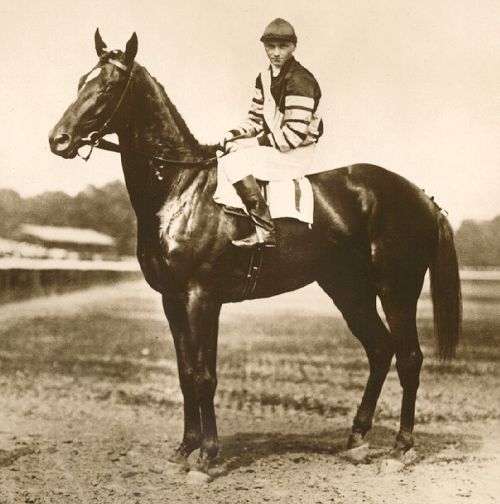
Man o’ War (1917 – 1947) is widely considered to be the best thoroughbred racehorse bred in America.  He would be voted the “Horse of the Century” by the venerable racing magazine, The Blood-Horse.  He won two-thirds of the American Triple Crown -- the Preakness and the Belmont Stakes.  But he never ran in the Kentucky Derby.  Why?

“The mostest hoss that ever was.”  This was how stud groom Will Harbut described Man o’ War (1917 – 1974.)  History would agree with Harbut.  The Blood-Horse would list Man o’ War as “The Horse of the Century.”  In his career, “Big Red” won 20 of 21 races and broke eight speed records.  He drew huge throngs of admirers to the tracks.  Many horse owners would not race their horses against him.  Visiting him in retirement was considered a pilgrimage by racing fans.  He would sire the Triple Crown champion War Admiral.

Yet America’s best racehorse never ran in America’s most famous race – the Kentucky Derby.  This was not due to injury.  Man o’ War’s first start at the age of three was in the Preakness Stakes.  Man o’ war’s owner, Samuel Riddle, purposefully kept his champion out of the Kentucky Derby (open only to three-year-olds.)  Why wasn’t he entered?

Scheduling

In 1920, the year Man o’ War was three, the Kentucky Derby was scheduled a mere eight days before the Preakness Stakes.  Back in 1920, racing twice a week was normal for most race horses.  Riddle would also campaign his horses this hard.  As a two-year-old, Man o’ War often had mere days to rest in between races.

But Riddle clearly thought that the Preakness and Belmont were far more prestigious races.  He wanted the pleasure of watching his champion colt trounce his competition close to his homes in Saratoga, New York and Glen Riddle, Pennsylvania.  There were no commercial airplane flights back in 1920.  You drove or took the train to get from one state to another.

Red’s Actual Age

Man o’ War actually turned three on March 29, 1920.  Due to the laws of Thoroughbred racing, all Thoroughbreds have an official birthday of January 1.  The argument was that this made it easier on the sport and made it easier for eligibility in age-restricted races.  In this way, the betting public would always know how old a horse was. 

Horses are not physically mature until they are five.  However, racing tradition demands that immature thoroughbreds begin running and making money for their owners as soon as they can carry a rider.  Riddle believed that Man o’ War was too young to run the Kentucky Derby distance of 1 ¼ miles.  The Preakness was shorter at 1 1/8 miles.

What Triple Crown?

In modern times, winning the Triple Crown is the Holy Grail of American turf racing.  But there was no Triple Crown back in 1920.  The term was not coined until the 1930s, when sports writer Bryan Field suggested strongly that America needed to have their own version of England’s Triple Crown. 

Man o’ War did not compete for the Triple Crown in 1920 because there simply was no Triple Crown then.  The Kentucky Derby was not seen as prestigious to race horse owners of the Northeast because it was a Southern race.

References
  • Man o’ War: A Legend Like Lightning.  Dorothy Ours.  St. Martin’s Press; 2006.
  • Man o’ War.  Page Cooper and Roger Treat.  Westholme Publishing 2004 (originally released in 1950.)
  • Portraits of Kentucky Derby Winners: A 120-Year History.  Beverly Bryant.  HCI; 1995.