Will thoroughbreds have a future?

Will thoroughbreds have a future?
Showing posts with label horse facts. Show all posts

Sunday, May 13, 2018

You Better Know The Rules For Riding A Horse On The Road

Image from Wikimedia Commons

In a match between a horse and a car, the horse will always loose.  Cars, trucks, drivers and roads suck, but they are an inescapable part of modern living if you want to ride horses.  You AND your horse needs to know the rules for riding a horse on roads.  If you or your horse cannot handle roads and traffic, you cannot risk riding on a road.

Rules You Need To Follow

Always keep in mind that drivers are the enemy.  It doesn’t matter that it’s illegal to hit a horse with a car intentionally.  They will still do it, because there are drivers out there who think it’s funny to kill animals with cars.  This might sound paranoid, but this kind of paranoia will save your horse’s life.  This is THE most important of the rules for riding a horse on the road.

Always dress in bright reflective colors.  This is one of the most important rules for riding a horse on the road.  There are many cheap and cheerful fluorescent colored vests you can buy.  If you have to, stick an orange “slow traffic” triangle on your back.  Consider that most horses are a shade of brown.  This color blends in with the surroundings.  Drowsy drivers will not see a brown horse, but will see the bright vest.

Reflective stickers and additions are also available for your horse.  You can put them on the saddle blanket, the brow band, or as wraps around the legs.  If you have to do any riding at dawn, dusk or evening, these are a good investment.

Always ride your horse facing traffic, if you can help it.  This is another of the most important rules for riding a horse on the road.  The horse will be less likely to panic if they can see what’s coming.

Rules Your Horse Needs To Follow

Your horse must be road wise.  There are no ifs, ands or buts about it.  It’s hard enough to sit a bucking horse without having to weave around traffic as well.  For the first time you ride your horse anywhere near a road, dismount and LEAD the horse until you are assured that he or she is road wise.

The other rules for riding a horse on the road are to keep alert.  Also, keep as calm as you can.  Horses can pick up your nerves.  Don’t ride alone on a road if you can help it, in case of emergency, you have help.  Ride with a cell phone for emergencies.  And praise your horse when he or she is behaving well.

Thursday, February 9, 2017

Appaloosa Horse Health Issues

Please do not use this article in the place of your veterinarian's advice.

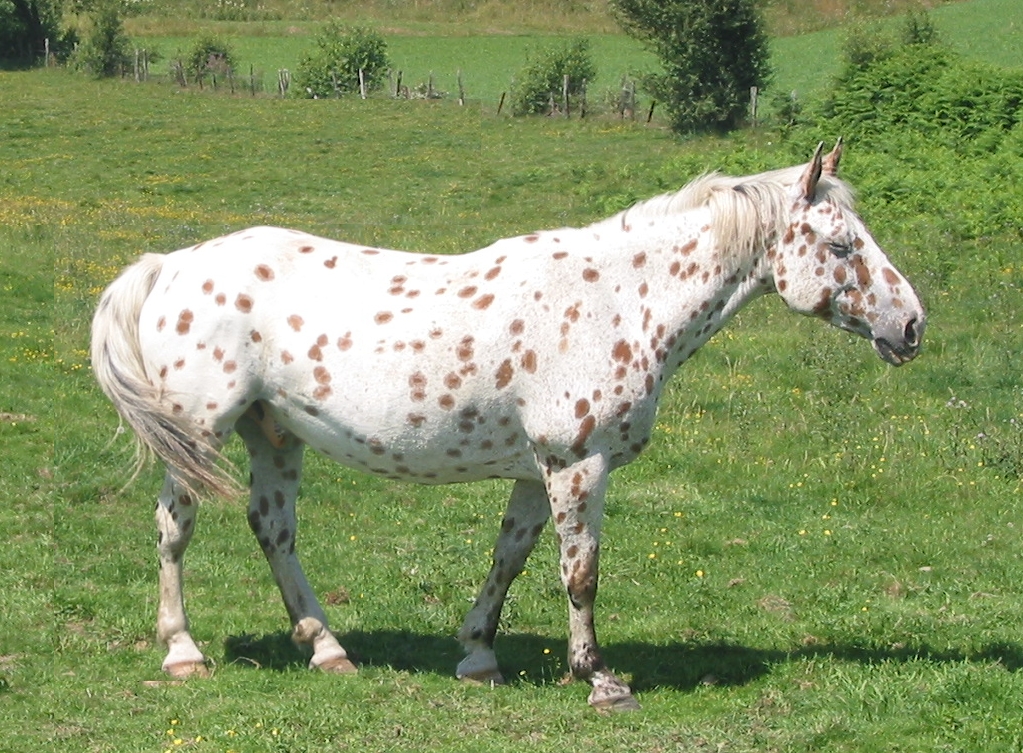
Appaloosas are impressive horses, even if they are “few spot Appaloosas” and have a few hard-to-spot spots. They're impressive to look at, impressive to ride and impressive in their characters about the barn. They also have an impressively sobering history linked to the near-extermination of the Nez Perce tribe. But if you want to bring an Appaloosa home, you need to be aware of their most common health issues.

Sunburn

Appaloosas that are predominately white, such as those who sport the leopard spotted pattern, are more prone to getting sunburn than horses of darker colors. They get sun burnt especially on any areas of pink skin, such as the muzzle, lips, ears and genitals in stallions and geldings. Even if the skin is mottled grey and pink, it still can get sunburnt. If a horse’s skin is constantly damaged by sunburns, it is prone to getting skin cancer.

Human sunscreen products that are safe to use around the eyes would be safe enough to protect your Appaloosa from sunburn. You also want to be sure there is shelter in their fields and paddocks.  If possible, keep pink-skinned Appys indoors during the hottest parts of the day.

Night Blindness

Horses can see very well in the dark unless they have night blindness. Although not the most traumatic thing that can happen to a horse, night blindness can make a horse accident prone. A one thousand pound animal getting into an accident can prove to be traumatic, indeed. So far, night blindness has only been discovered in Appaloosas. It is thought that the gene that is responsible for the Appaloosa's spots can also cause night blindness. But few spot and "snowcap" Appaloosas can still be born night blind.

Congenital stationary night blindness tends to not get worse as the horse gets older, but you do have to arrange for the horse to either be close to a "seeing eye" horse or to be stalled all night. You definitely have to curtail riding at night. Lightning flashes can also make the horse temporarily blind. Usually an Appaloosa is born with the condition, but we are still in the early stages of learning about it.

Total Blindness

A 2006 study by the University ofMinnesota concluded that Appaloosas were eight times more likely to gocompletely blind than any other breed of horse. This might also be due to genetics, but so far, the reason why a horse gets this disease is unknown. Appaloosas seem to be more prone to contracting a disease called ERU (Equine Recurrent Uveitis) which then causes the blindness. This is also called "moon blindness". Not all horses with ERU go completely blind.

Although blind Appaloosas can be great companions and can be used in riding and pulling carriages to some extent, most people do not want to deal with them and just have them put down. More and more, people are opening their eyes to the fact that living with a blind horse isn't too much different than living with a sighted horse.

Additional References


Image from Wikimedia Commons

Monday, February 6, 2017

3 Main Differences Between Horses and Zebras

Is a zebra a black horse with white stripes or a white horse with black stripes? Actually, zebras are very unlike horses in temperament and physical appearance. However, both zebras and horses share similar herd social structures. Horses and zebras can mate, although the resulting offspring, zebroids or zorses, are sterile. Zebras can also successfully mate with ponies and donkeys, producing zonies and zedonks, respectively, but these are also sterile.

Body Build (Conformation)

Zebras more closely resemble donkeys than horses in conformation. Their ears are long like a donkey's. The manes are short and stand stiffly upright, like a donkey's rather than the long flowing manes of horses. Some breeds of horses such as the Fjord have a mane that will grow up stiffly like a zebras for a couple of inches, but then it falls over. Zebra manes usually grow very short so they never have a chance to fall to one side.

Zebra tails are also built like a donkey's instead of a horse's. They resemble a paintbrush in that the only part covered with hair is at the end. Horses tend to have tails entirely covered with hair.
Zebras also lack withers that horses have. Withers are a slight bump where the neck meets the shoulders. Having withers makes it far easier for a saddle to stay in place. Although differences vary in individual zebras, many zebras have a mostly level spine instead of a dip from withers to middle of the spine and up to the rounded hindquarters seen in many horse breeds.

Vocalization

Both horses and zebras have a wide range of vocal displays from a snort to a scream. Both species can snort and nicker, but the horse whinnies in a more brassy way than a zebra, which "hee-haws" like a donkey.   Zebras will also make barking sounds similar to geese honking.
In contrast, horses can whinny, which can sound quite shrill or even similar to a bugle.  When aggressive, horses can emit a chilling roar.

Temperament

This is the biggest way in which horses and zebras differ. Horses will readily be domesticated. Even feral horses that have spent years living on the range can be domesticated if given a patient and forgiving trainer. But, outside of a few instances using questionable training methods, zebras will not have anything to do with pulling a carriage or letting someone ride them.

In this way, zebras are identical to Przewalski's horse (Equus ferus przewalksii) in that this species refuses to be domesticated.  There have been rare individuals that have been able to pull carts or temporarily allowed themselves to be ridden.  However, Przewalksi's horses are a different species than domestic horses (Equus caballus) in that they have a different number of chromosomes. Domestic horses only have 64 while the Przewalski has 66. A zebra, in contrast, has 44 chromosomes. Both horses and zebras are prone to spooking, but this instinct is intense in the zebra or in zebroids.

Image of a zorse by Christine and David Schmitt for Wikimedia Commons